
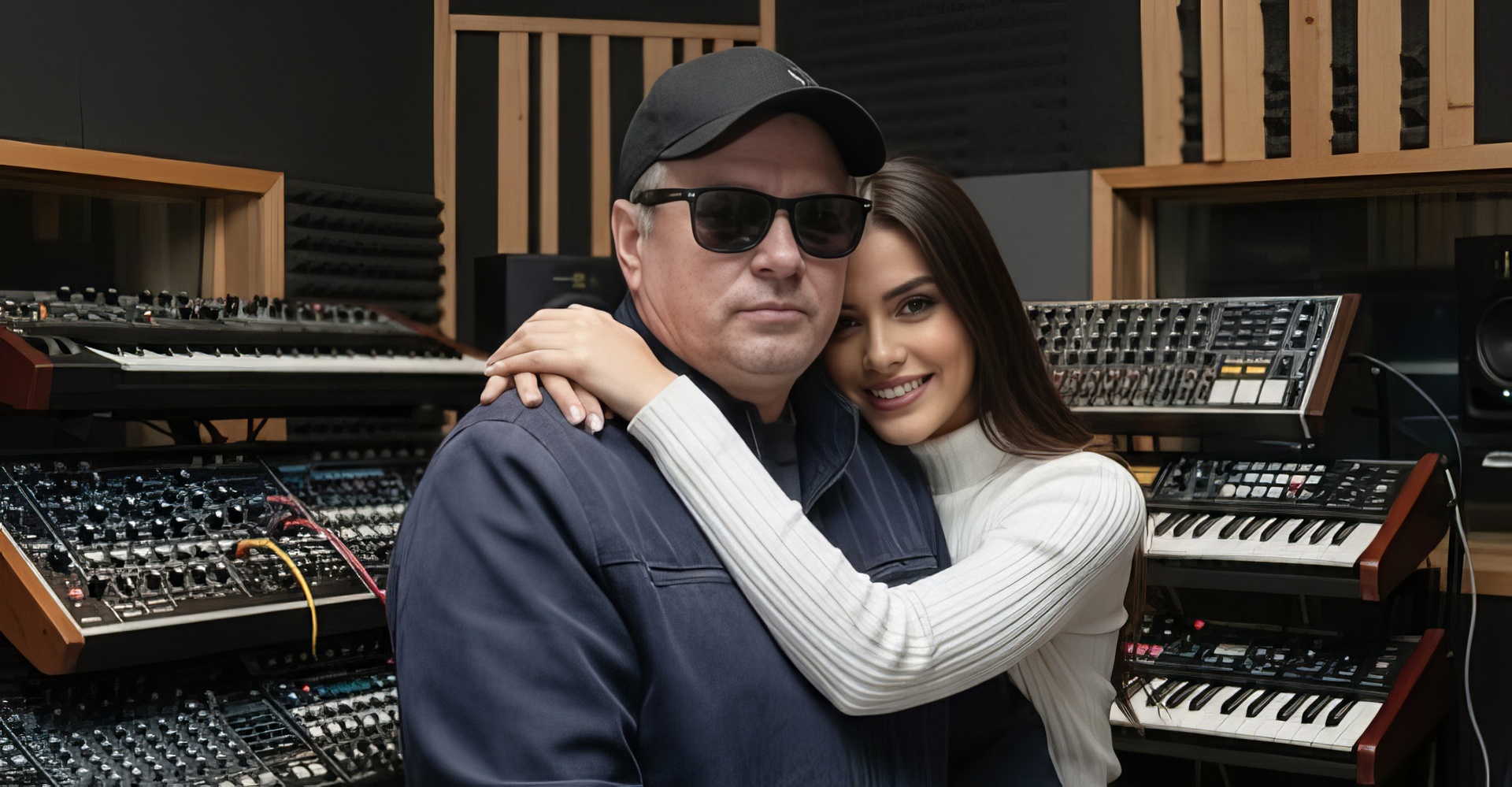
From synth-driven songwriting in Kazakhstan to listeners around the world, producer INKAZ explains how he built a virtual singer with a distinct musical identity — and why the human touch still matters in AI-assisted music.
CYBEROCTAVE INTERVIEW | ARTIST FEATURE
Artificial intelligence is changing the way music can be written, performed and produced. But technology alone does not create an artist. A lasting project also needs a point of view, a recognisable sound and a reason for listeners to return.AI.KA Digital Singer is an attempt to bring those elements together. Launched on 8 April 2024 by Kazakhstan-based musician and producer Igor Nareiko, better known as INKAZ, the project pairs an AI-assisted female vocal identity with the melodic language of 1980s European pop. It draws on Italo Disco, Euro-pop and synth-pop, while keeping its focus on romantic lyrics and contemporary electronic production.We spoke with INKAZ about the origins of AI.KA, the craft behind each track, the project’s international audience and the balance between human creativity and artificial intelligence.
1. The birth of a digital singer
CyberOctave: Igor, how did AI.KA Digital Singer begin?
INKAZ: It started with experiments. As neural-network tools became more accessible, I wanted to see what would happen if I combined an AI-generated vocal with music I had written on synthesizers. At first, I wasn’t setting out to build a complete virtual artist. It was simply a creative experiment. But after many tests and different versions, the idea of a digital singer with her own vocal identity, musical direction and visual image began to take shape. We consider 8 April 2024 the official starting point of the project.
CyberOctave: Why did you choose the AI-artist format?
INKAZ: It gives me new ways to work with a vocal performance. I can test different approaches, refine the delivery and keep exploring until the voice fits the song. But I don’t believe AI automatically makes music good. Just as with a human performer, the result depends on experience, persistence, musical judgement and a lot of detailed work.
CyberOctave: Where did the name AI.KA come from?
INKAZ: The name appeared almost by accident. AI.KA was one of the strongest models to emerge during the experiments, and eventually I felt that this was the identity I wanted to keep. The “AI” part points to artificial intelligence, while “Aika” also works naturally as a female name. The dot makes the written name distinctive and part of the project’s visual identity. The name AI.KA Digital Singer has also been registered with RAO.
CyberOctave: How important is the singer’s visual identity?
INKAZ: It is just as important as the music. I wanted listeners to recognise AI.KA not simply as a voice appearing on different tracks, but as an artist with a consistent image and personality. That is why we maintain a clear visual concept and feature AI.KA on our release artwork. There is also a personal detail behind the image and the original voice model: they are connected to my daughter. She is not directly involved in the project and jokingly calls herself “the singer who doesn’t sing”. Still, her opinion as a listener matters a great deal to me.
2. Why the sound of the 1980s still matters.
CyberOctave: AI.KA is closely associated with Italo Disco, Euro-pop and the synth-driven sound of the 1980s. Why did you choose that musical world?
INKAZ: The music of the ’80s has always been close to me. It was the soundtrack of my youth, and I still feel that the era had a special sense of melody — something that can sometimes be missing from modern pop. I was inspired by artists such as C.C. Catch, Sandra and other performers of that time. Their records brought together memorable melodies, expressive synthesizers and emotional lyrics in a very direct way. I’m not trying to copy the past. I want to keep its atmosphere and melodic spirit, then present them through a contemporary production approach. So AI.KA is not simply a retro act. It is a modern interpretation of Italo Disco, Euro-pop and synth-pop with a clear 1980s influence.
CyberOctave: Would you say AI.KA has a clearly defined musical identity?
INKAZ: Absolutely. I believe every artist — virtual or human — needs a recognisable musical identity. I’m not especially interested in making one project sound like rock today, jazz tomorrow and something completely different the day after. Experimentation is important, but listeners should have a sense of what an artist stands for. AI.KA’s musical territory is melodic electronic pop, romantic lyrics, a female vocal character and the atmosphere of European pop from the ’80s. The music, voice and visual identity all need to belong to the same world.
CyberOctave: Most AI.KA songs are performed in English. Was that a deliberate decision?
INKAZ: Yes. From the beginning, I wanted the project to reach listeners in different countries. But writing an English-language song is not simply a matter of translating a poem. The words have to sound natural, fit the rhythm, carry memorable hooks and communicate the right emotion. We pay close attention to adapting lyrics for an English-speaking audience. The goal is for each song to feel like a song written in English, not a literal translation from another language.
3. Inside the AI.KA production process.
CyberOctave: Some people imagine that AI music is made with a single click. What does the process actually look like in your studio?
INKAZ: There is quite a lot of work behind every finished track. It usually starts with the lyrics. For me, the words are the foundation of a song. I mostly write the first version in Russian, although sometimes I begin in English. Then comes the adaptation: the lyrics need to feel natural to an English-speaking listener, with the right rhymes, hooks and memorable lines. AI tools can help with that process, but the final editing decisions are mine. The next stage is choosing the music. I keep a personal bank of musical sketches that I develop between songwriting sessions. Many of the initial ideas are created on my KORG Pa500 and Yamaha PSR-300 keyboards. I then take the material into SUNO, where we work on AI.KA’s vocal, explore different performances and develop the arrangement. I compare the versions and select the one that best matches the song. After that, the track goes through further processing in a DAW and final mastering.
CyberOctave: How long does it take to complete one song?
INKAZ: It varies. Sometimes a track comes together quickly; other times I leave it for a while and return to it later. On average, a successful song takes around three to seven days from the first lyric to the final master. It is also quite common to generate between five and ten versions before I find the result I really want.
CyberOctave: What is the most challenging part of making AI-assisted music?
INKAZ: The hardest part is not getting a good sound. It is getting the right emotion. Today, it is possible to generate a technically convincing performance, but a song needs to do more than sound polished. It should tell a story, communicate a feeling and leave something with the listener. That matters especially with ballads. A beautiful arrangement and a good voice are not enough; the listener has to believe in what the singer is expressing. That is why technology is a means to an end for us, not the end itself.
4. Songs that travel beyond borders.
CyberOctave: Which release marked the beginning of AI.KA’s official catalogue?
INKAZ: It is difficult to identify the very first song created during the experiments, but I would consider “I’m Waiting for You” the project’s first official release. A first release is always special. It is the moment when an experiment becomes a real music project.
CyberOctave: Which tracks have made the strongest connection with listeners?
INKAZ: Several songs have found particularly strong audiences. “I’m Forgetting You”, for example, became unexpectedly popular in China. It appeared in various rankings and charts, and Chinese fans even made their own video for the track. We discovered it by chance, partly because access to some Chinese music platforms can be limited from outside the country. “Don’t Say a Word” and “Only You (I Follow You)” have also become important tracks in our catalogue. They have accumulated millions of streams and continue to be popular among fans of Italo Disco and Euro Disco. Still, I don’t want to measure the project only in numbers. What matters most is how people feel when they hear the songs.
CyberOctave: If someone is discovering AI.KA for the first time, which songs would you recommend?
INKAZ: I would suggest starting with “Together”. It gives you a good sense of the more lyrical side of the project. If you prefer something more dance-oriented, try “July Rain”. And I would also recommend “The Road Back Home”, which is one of the most personal songs for me.
CyberOctave: What makes “The Road Back Home” so personal?
INKAZ: It is about the family home — the place where you are always loved and where someone is waiting for you. Sadly, for me, it is now a memory of something I can never get back. I still find it difficult to listen to the song without tears. Perhaps that is why I value music with a real story behind it. A listener can take that story and find something of their own in it.
CyberOctave: Have any fan messages stayed with you?
INKAZ: Yes, and some of them are extraordinary. One listener told me that his son was born while he was listening to AI.KA’s music; he shared the news with us while playing another one of our songs. A fan in Spain told us that one track seemed to describe his own breakup so closely that he still cries whenever he hears it. Messages like these mean more to me than many formal statistics. They show that a song can become part of somebody’s personal story.
CyberOctave: Has AI.KA built a community of regular listeners?
INKAZ: Yes, and we make a conscious effort to support that community. We have official social-media accounts where listeners can talk, share their reactions and discuss new releases. We also run competitions to recognise our most active fans, with prizes and branded merchandise. I don’t want the relationship between an artist and an audience to end with a play button. We want to build a real community of people who feel connected to this music.
5. Working with human musicians.
CyberOctave: Can a virtual singer work naturally with real musicians?
INKAZ: Of course — and we are already developing that side of the project. One important collaboration is with musician and composer Oleg Rysyev, known to Italo Disco fans as Olegris. We have released several tracks together and plan to continue working with him. It is a chance to bring different musical approaches and experience together. Another significant collaboration is with TranceForm Project. That partnership introduced AI.KA to a new direction: melodic trance. Her vocal character works particularly well with the atmospheric, melodic sound of TranceForm Project. It has helped us reach a new audience while allowing AI.KA to explore a different genre without losing her identity.
CyberOctave: Does the combination of a virtual singer and human musicians create any contradiction?
INKAZ: I don’t see a contradiction. Music has always moved forward through new instruments and technologies. Synthesizers changed the way people thought about music production when they appeared; AI is opening another set of possibilities today. What matters to me is not how a sound was made, but what the listener hears in the finished track. I would also like to create a full duet between AI.KA and a live vocalist one day. I think that could be an interesting experiment.
6. AI, authorship and the human touch.
CyberOctave: How do you respond to criticism of AI-generated music?
INKAZ: I welcome thoughtful criticism. Artificial intelligence is, first of all, a tool, and in capable hands it can be a valuable part of a musician’s workflow. Of course, there is now a huge amount of music being produced with almost no human direction. But I don’t think all AI-assisted music should be judged as one category. There is a difference between generating a random track with one click and building a complete production: shaping the concept, writing lyrics, creating musical ideas, selecting versions, editing and preparing the final release. Ultimately, listeners decide whether a song works for them. I believe musical taste and quality should be the main criteria, not the tool used to make the record.
CyberOctave: Where do you draw the line between human creativity and AI?
INKAZ: I think everyone has to find their own balance. In my case, if I had to describe the process in percentages, I would say it is roughly 60 per cent human input and 40 per cent AI. That is not a strict formula, of course. It is simply a way of explaining my approach: the human creator should remain responsible for the concept and the final result.
CyberOctave: Can a virtual singer create genuine emotions in an audience?
INKAZ: Judging by the messages we receive, yes. The emotion does not have to exist inside the technology; it happens in the person listening to the song. If a track helps someone remember a loved one, get through a breakup, feel hopeful or simply smile, then it has done what music is meant to do. For me, that is what matters most.
7. What comes next for AI.KA Digital Singer?
CyberOctave: What are your plans for the near future?
INKAZ: We are continuing to expand the catalogue, write new songs and develop collaborations with other musicians. I’m especially interested in working with artists who have a distinctive musical identity of their own. Those partnerships allow us to broaden the repertoire and discover new ways to express AI.KA’s character. Another ambition is to create more complete visual performances for music videos. We have already made some attempts to create a singing version of AI.KA, but it is a demanding process in terms of both time and resources. I hope we can return to that idea as the project develops.
CyberOctave: Where would you like to see AI.KA in a few years?
INKAZ: Forever young and incredibly popular! (Laughs.) More seriously, I want AI.KA to remain a recognisable artist with her own character, musical direction and loyal listeners. I’m not interested in chasing every passing trend. I would rather keep developing our own musical world and making songs that connect with people, wherever they live and whatever their age.
CyberOctave: Finally, what would you say to someone hearing AI.KA Digital Singer for the first time?
INKAZ: Give the songs a chance. You may find one that becomes part of your own story. We are constantly developing, experimenting and preparing new music, and the people who listen, leave comments and share their feelings give us the motivation to keep going. AI.KA is still a young project, and there is a lot ahead of us. I believe the most interesting part of the journey is only just beginning. Stay with us. Always with you — AI.KA and INKAZ.
AI.KA Digital Singer — at a glance
Project
AI.KA Digital Singer - Founded 8 April 2024
Country of origin - Kazakhstan
Creator and producer - Igor Nareiko, known as INKAZ
Format - Virtual singer / AI-assisted music project
Musical styles - Italo Disco, Euro Disco, Euro-pop, synth-pop and melodic trance collaborations
Main vocal language - English
Creative concept - Melodic electronic pop inspired by the 1980s, presented through contemporary production
Collaborations - Olegris (Oleg Rysyev); TranceForm Project
Official website: 🌐 www.aikadigital.info
Official YouTube: 📺 YouTube:
AIKA Digital Official Channel
💌 aikadigitalsinger@gmail.com
AI.KA Digital Singer — where artificial intelligence meets real emotions.